Wednesday, September 5, 2012

Day 25: Niihama – Mima


[post of Sunday 2nd of September 2012]

We break all previous records and wake up at 5am, but not because we wanted to. The fire alarm in the room has gone off, and it doesn’t shut up… not even when we remove the batteries. Finally, when we manage to switch off the faulty fire alarm, we also switch off our alarm and sleep a bit longer. It doesn’t matter if today’s stage is another one of 100 km, or that we have a difficult up-hill in the middle of it. If we don’t get to our final destination, we can always give a call to our next host, and camp somewhere outdoor. The most important thing is to enjoy the trip, not to go crazy or die in the effort of following the original plan. We’re working ahead of time and putting this in writing, just in case we need to give that call, and we get (or not) to Mima too late.

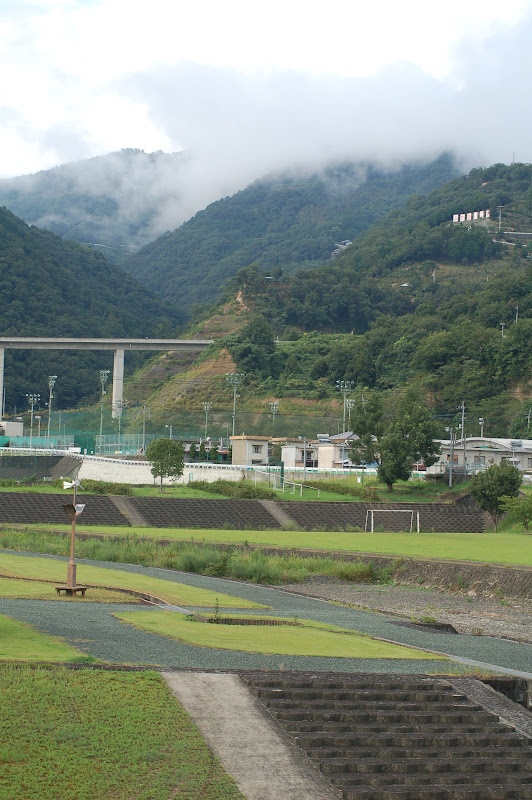
It rains the whole day except when we have to cycle up-hill and, even better, when we get down-hill afterwards. We thank the kamis and keep on going through one of the most beautiful valleys we’ve seen so far, in the middle of a rural environment, through a road without traffic. Today’s stage is truly dangerous, with the constant possibility of your gaze getting trapped into the view and away from the road… but that’s unavoidable after all. We stop as many times to take pictures as those in which the rain stops. You must go and see it yourself.

Midway through the afternoon, some of the clouds go away and the sun shines again… but it’s still raining. We want to know exactly which cloud is getting us as wet as a soup (so to speak!). We have a swimming pool in each shoe, and it’s getting cold. In front of us, the rainbow is the main gate to Mima… we’re there! Thanks to the beauty of the valley distracting us, we’ve arrived smoothly enough, and not as late as we thought this morning. Our host, Mika, greet us in the street and we enjoy a lovely dinner with her and her husband.

We cannot believe that what we are experiencing all the way through the trip is just good luck. We’re sure the kamis have blessed us. We’re gonna miss them when we go back to Spain.


Day 24: Shimanami Kaido – Niihama


[post of Sunday 2nd of September 2012]

Since yesterday we stopped midway the stage, today we have to get over 100 km counting what’s left over from the Shimanami Kaido and what we have to do for today’s stage. Luckily through the Shimanami Kaido it’s easy to cycle. Better said, luckily Ainhoa can cycle easily through it. Gabriel’s bike is nearly gone. The bigger disk of the back wheel doesn’t work; the medium one only gets you to put one gear, plus another gear on the small disk. The chain keeps getting off and, as if that wasn’t enough, we also face a strong wind blowing us backward. Would Gabriel’s bike last any longer?

We finish up the Shimanami Kaido with the last 6 km as we cross the last bridge. We arrive to the Imabari and visit the castle there… as if we had extra time to spend wondering around, and there weren’t people waiting for us. Far away, we see dark clouds announcing a storm… just what we needed!!!

From Imabari to Niihama is pure plain road but Gabriel’s bike doesn’t get over 12 km per hour, when it goes well. We cannot go on like this. Gabriel says that we’ll stop at the first mechanic we see and, as always, the kamis are listening to us; five minutes later we see a mechanic for bicycles along the road. Without thinking in what time is, we stop by and show the bike to the mechanic; he practically fixes it up instantly. The cassette had moved and the chain was getting off because of that; we had to change both of them, revise all the gears, a little check-up… and the bike is brand new! We move from 12 km/h to nearly 40 km/h, and we’re ready to get to Niihama before night. Then it starts raining or, better said, pouring down like hell. At some point there was so much water that it reached up to our calves. We’re soaked with water, it’s already dark, and we have to find the house of our host, which we find at 7,30pm. Hot shower, lovely dinner, some beers, and we’re recovered.


Day 23: Higashihiroshima – Shimanami Kaido


[post of Sunday 2nd of September 2012]

We say goodbye to Koubun and her flatmates, and head off to today’s stage in the best way possible, down-hill. When we decided our route for the trip, we planned it trying to get to visit the more interesting places along the seacoast, at the same time that we avoided the hardest roads in terms of the average of up-hill and down-hill we had to face. However, as days go on, the body gets used to the task of doing cyclo-tourism, so we are getting more trained for the parts up-hill of the trip. In addition, to travel with your partner has both positive and negative sides. It looks like now we get up-hill in a more confident way, with less effort than in the first days… even thou the force that pushes you to keep on going is pride more than love. To feel pride is tricky and, most of the times, useless. To get to share this great experience with your other half is a treat, and a great one, but there are both good and bad days. When tiredness piles up, and the warm melts up your good sense, you direct you frustration toward the only other person with you. Alice from the “Rodadas” pages is right; when you have an argument with your partner, and you live together, you can always get out and have a walk… but in a stage you’re doing together, there is no such thing as a way out. However, you still need to put some time aside to talk, to discuss today’s stage and plan the way to face it together, to tune your cycling with that of the other and, above all, to put that useless pride in the saddlebag. Today is the day for all this.

We go from Higashihiroshima to Onomichi through a beautiful road, although it seems that all Japanese tracks have decided to pass through it. Some (few) track drives beep us; some to cheer us up and goodluck, the other because we’re slower than them; other don’t care about the safety distance and we get to breath their track’s smoke… then you get these special persons we’ve been meeting all the way through here in Japan. A track driver beeps us and then stops along the road, to wait for us. When we get there, he comes out from the track with an Aquarius bottle and a huge smile on his face. We have a rest for a little while, and a chat about the trip in JapanEnglish. These people are great!

When we get to Onomichi, we have a walk around through the city. For a change, we take too long and it’s late. Today the idea was to stop midway through the Shimanami Kaido, a route for bicycles of some 70 km. The Shimanami Kaido cuts through a series of small islands between the Great Honshu and the Shikoku Island. We are a bit disappointed by the fact that this route is publicised as ideal for bicycles, one of these routes where you are not bothered by the traffic… instead there is little difference with any other road with a pedestrian/bicycle way as those we found before. The state of the road is better than other roads, that’s true, and there are very few cars. However, this is not the most beautiful route of Japan, nor the more breathtaking. The most spectacular aspect of the Shimanami Kaido are the bridges that cross over from island to island, real pieces of mega-architecture. 

It’s already late and is getting dark; we’ve got neither food nor a place where to sleep. The nearest camping is at 15 km. The surroundings are not that wild as no to allow to camp there. We decide to keep going until we find a place where to eat and, then, to go back to the camping we’ve just passed. Like in Miyajima, the camping is closed so we cannot use the facilities (or take a shower), but we assemble the tent in a nice spot, a beautiful plain beside the beach… and we have dinner under the full moon.


Day 22: Miyajima – Higashihiroshima


[post of Sunday 2nd of September 2012]

Last night Gabriel didn’t sleep too much, so he could count the 7/8 earthquakes that have happened overnight. We’ve camped on a wood platform so it’s a lot easier to feel all vibrations from underneath. Even so, it’s Gabriel the first one in waking up today, before Ainhoa. He takes this time trying to fix his bike, not for the first time. The sound it makes when we cycle is worse every day, the gears more and more difficult to change… we fear the worst soon. Would the bike last until Osaka? At least, would it last until we find a mechanic for bicycles?

We go back cycling up and down hills the two hills between the camping and Miyajima sanctuary. This early in the morning there are more deer than tourists. Gabriel thinks that the deer have been brought in here for the children, so they are entertained while their parents visit the sanctuary.

The famous “torii” of Miyajima [the famous floating gate to Itsukushima Shrine] is really interesting, and it impresses us. Probably, that’s because of the many pictures of it spread around in the sanctuary, on each door, which contribute to the whole effect. In any case, this sanctuary is beautiful, and everything around it (included the souvenirs shops) are very interesting. By the time we leave to go on with today’s stage, the whole place is packed with people.

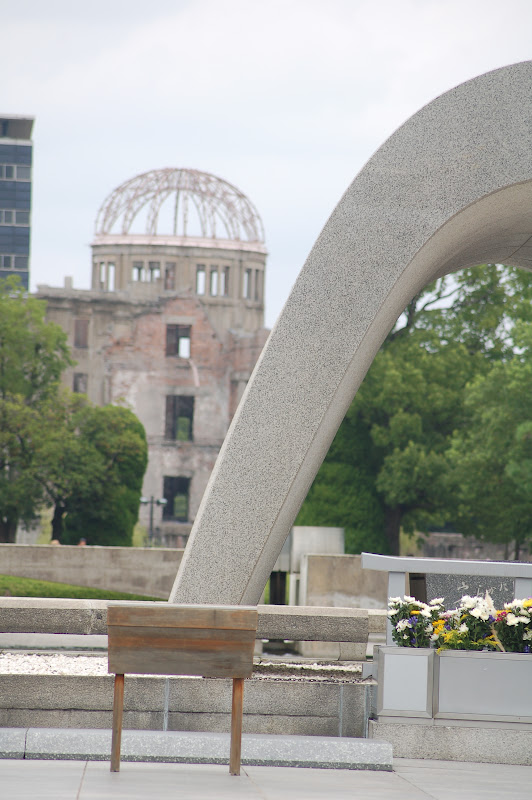
We get onto the ferry that goes straight from Miyajima to the Peace Hall of Hiroshima to visit the museum and garden of the atomic bomb. The ticket of the ferry is some 20€ and it takes something like an hour to get there. Gabrile takes this chance to have a little nap, while Ainhoa writes down this few lines for the blog. If you go to Hiroshima, don’t forget there is this ferry. Just check the timetable out beforehand. There are few ferries per day doing this route, but the visit to Hiroshima Peace Hall is certainly worth a visit.

The museum is impressive. Its walls are soaked with history of the city of Hiroshima, as well as that of the development of the war. The majority of the tourists go straight to the section about the effects of the bomb. We think it’s better to know how ‘this’ was brought about before going straight to ‘see’ the tragedy. Those were the last days of WWII: Japanese maritime forces we totally wrecked, US weaponry targeted it as if they were of paper, and the high level of the decision making department were not in agreement on what to do next. To attack directly the cities caused high numbers of casualties, such as many hundreds of thousands. It looked as if the war would never end, that Japan would never surrender, and every single Japanese inhabitant would become soldiers. US decided to put an end to the war in the most radical way. They had four atomic bombs ready; the first one exploded in the skies above Hiroshima, destroying everything in the 2,5 km radius around. The Japanese government had already decided to surrender but had not reached an agreement in accepting all the condition of the treaty. Instead of waiting for the Japanese  to reach a new agreement, it was decided to use another bomb, which was set to explode in Kokura. The pilot could not see his target due to the bad weather, so changed its route, and target, and headed toward Nagasaki instead, where it happened the same that had happened in Hiroshima. Both Nagasaki and Hiroshima are still suffering the consequences of the explosions, and they are doomed by atomic energy.

When we leave Hiroshima, we are silent. We’re still ‘digesting’ what we’ve seen and heard in the museum, but we cannot stop any longer. There are 30 km left of our stage today, we have to literally climb a mountain, and there are few hours left before the night. At the end, we get to Higashihiroshima, a tiny city (mostly un-known to tourists) lost in the middle of green valleys. Here we spend a lovely night in the house of our next host, Koubun.